


SURVEY RESULTS
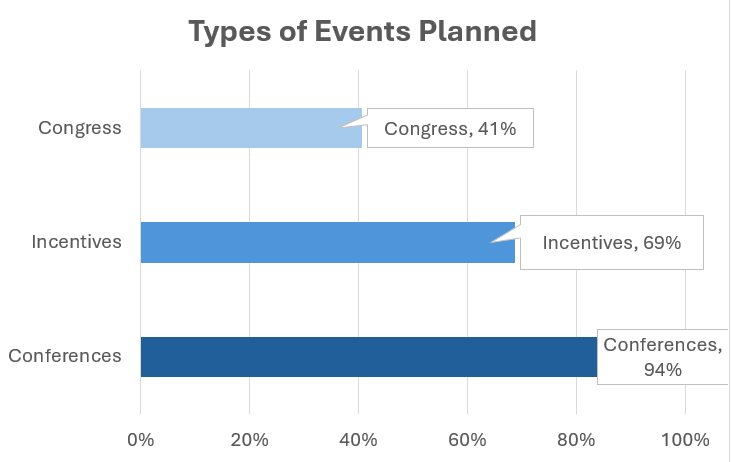
In our survey at the end of 2025, we asked UK event planners their opinions on our destinations, what they want to see from DMCs and what barriers are there when considering certain destinations. 87% of respondents were agencies and 13% were corporate clients. Overall, we found the highest destination interest was for Portugal, Spain, Italy, Croatia and Dubai. Conferences were the most common event, with 94% of respondents. Then, incentives at 69% and congress at 41%.
It’s important for us to keep up with changes in the industry and stay connected to our event planners who we have great relationships with. In a rapidly changing world, we want to stay one step ahead of any trends or challenges which may come up.


EVENT PROPOSALS
When it comes to event proposals, event planners are looking for a reliable DMC who can deliver good quality proposals quickly. Many respondents also mentioned they wanted unusual, unique proposals which stand out from others. It should include venues they wouldn’t necessarily think of – hidden gems with character. Sustainability and environmental responsibility are also important. Event planners don’t want the environment to come as an after-thought; it should be an important part of the process, factored into the initial proposal.
Respondents said the challenges preventing them from taking events overseas are budget, availability, location and flights. Long-haul destinations such as India or Saudi Arabia are difficult for clients to organise due to factoring in additional travel days. And popular destinations like Spain often struggle with availability in peak months, making it harder for clients to choose the destination for events. We received a variety of responses about events within the UK. Whilst some respondents have noted more events are being held in the UK, most haven’t noticed any difference. And some say they are seeing more internationally.
Some of the questions we asked were:
What challenges are preventing you from taking your event overseas (flights, politics, budget)?
The main challenges identified by event planners are budgets, location, availability and flights.
Event planners shared a mix of confidence and caution when it comes to taking events overseas. While several reported no challenges at all, others highlighted shifting company policies such as asking attendees to book their own transfers and dinners, tighter budgets, and travel bans for certain delegate levels. Many noted slower commitment to confirming events, short lead times affecting availability, and a lingering perception challenge around hosting events abroad. Practical considerations also surfaced, including security concerns, market demand, rising prices, and the need for destinations with strong international access and good global connectivity. Some planners mentioned that political situations, conflicts, natural disasters, and the general desirability of certain regions can influence decisions. Environmental impact particularly long‑haul flights were another factor, alongside nervousness about what 2026 may bring, with some companies holding back. Sales teams not meeting targets, unrealistic client budgets, and broader organisational caution were also cited. Despite these barriers, most clients confirmed that overseas events remain a core and valued part of their business.
Are you finding more events are being held in the UK? If so, why?
Some event planners find there has been no difference in the number of events held in the UK, but others say more events are being held in the UK than overseas due to logistics, ease, sustainability and costs.
Event planners reported a mixed picture: some are seeing an even split between UK and international events, while others have delivered more overseas programmes, particularly for incentives, which continue to favour desirable international locations. A few noted that travel bans had temporarily pushed more events back into the UK, and that when ETIAS comes into effect some clients may again prefer domestic options, especially for UK‑based attendees who value shorter travel times and the sense of safety that comes with staying local. Environmental responsibility is also influencing decisions, with more clients wanting to minimise travel and avoid long‑haul commitments, and many businesses being cautious about planning too far ahead. At the same time, several planners have seen growth in their overseas events, even as the UK remains attractive for its cost savings on flights and overall budget efficiency.
Considering the rise of AI, what do you believe will be the added value of a DMC in the near future?
Most UK event planners believe DMCs are a valuable resource which make booking events easier. They don’t see a future where AI replaces local knowledge and contacts within the destination because it lacks human expertise.
Event planners agreed that while AI will undoubtedly streamline processes and provide faster access to information, the true value of a DMC lies in its human expertise, cultural understanding, and on‑the‑ground problem‑solving. They emphasised that a DMC brings real‑time creativity, contingency planning, and personalised experiences that technology simply cannot replicate. It was noted planners use a DMC because AI is still a buzzword in events industry it is helpful, but unable to meet and greet guests in person, manage health and safety, handle emergencies, or replace the reassurance of a trusted local team. Planners highlighted the irreplaceable benefits of local knowledge, supplier relationships, language skills, hidden gems Google can’t find, and the ability to navigate a destination’s every corner. They stressed that people buy from people, and the human touch, personal recommendations, and deep destination insight will always outweigh AI. Ultimately, they agreed that working with trusted partners like STAR Your World delivers organisation, ideas, added value, and the face‑to‑face connection that keeps this industry thriving.
What are clients expecting from the DMC of tomorrow?
Clients in the UK are looking for a DMC which can put together an efficient, unique, trustworthy proposal which is personalised to the needs of the end client. They value DMCs which work quickly and transparently without cutting corners on quality.
Event planners are looking for DMCs that deliver innovation, speed, and highly tailored proposals, built on deep local expertise and the ability to offer unique, out‑of‑the‑box experiences that simply can’t be found online. They expect excellent communication, fast response times, and proactive thinking, with a DMC that can interpret a brief intelligently and present creative ideas, exciting venue options, and solutions shaped by genuine destination knowledge. A modern DMC must demonstrate flexibility, sustainability, and strong CSR values, alongside transparency of costs, better negotiating power, and the agility to leverage technology for smarter, more efficient operations. Planners want personal service, attention to detail, problem‑solving capability, and full‑service support, including risk management, cultural sensitivity, and reliable emergency assistance. Ultimately, they expect a partner who brings new ideas, smooth operations, strong local contacts, and exceptional, memorable experiences, delivered with reliability, value for money, and a consistently high standard of customer service.
What are the key differentiating factors, beyond pricing, that should be taken into account when evaluating a proposal?
Event planners are looking to work with a DMC which can work together with them to ensure the proposal is delivered quickly. Unique, unusual ideas make the proposal stand out from others. They also want a greater focus on sustainability.
- Trust, Confidence & No Surprises
This is the biggest theme by far planners want to feel they are in safe hands.
- No surprises, transparent, accurate, correct first time
- Confidence in the DMC’s ability to deliver
- Strong local expertise and risk anticipation
- Seamless logistics and emergency support
- Reliable supplier relationships
- Clear T&Cs, especially around changes and cancellation
- Creativity, Innovation & “Wild Card” Thinking
They don’t want a brochure. They want imagination.
- Innovation and inspiration
- Unusual ideas tailored to the client
- Creative thinking beyond the brief
- Wild card options
- Distinctive, memorable concepts with a clear USP for the proposal
They want to be surprised but with ideas that are feasible and confidently presented.
- Unique Local Experiences (Not Found Online)
This is where DMCs should shine.
- Authentic, local, exclusive experiences
- Social enterprise or meaningful community elements
- Activities that stand out from the ordinary
- Cultural insight and storytelling
- What will the client remember about the trip
- Clarity, Simplicity & Professionalism in the Proposal
Planners don’t want messy, confusing, or incomplete proposals.
- Clear, readable, simple structure
- Correct costs first time – clear proposal and pricing
- Answering all questions raised
- Matching the brief with added extras
- Images and case studies to bring it to life
A clean, confident proposal beats a long, complicated one.
- Collaboration, Communication & Chemistry
They want a partner, not a supplier.
- Efficient communication
- Collaboration working together
- Chemistry meeting before solution design
- Understanding the event’s purpose and vision
They want to feel the DMC that “gets it” before they even start writing.
- Practical Destination Factors
These matter, but they’re not the differentiators
- Location
- Flight connections
- Dining options
- Meeting space
- Seamless transport
- Food and service
- Sustainability practices
- Commissionable F&B rates for agencies
These support the proposal — they don’t win it alone.
IN SUMMARY
94% of respondents said they see Spain and its islands as potential destinations for incentive travel. Many of them already use the destination and love it. When asked what would make event planners decide against Spain, most said there are no problems with the destination and they wouldn’t stop using it for events. Some noted that the only reason why they wouldn’t choose Spain is due to availability and their clients’ decisions. Around half of respondents haven’t used Slovenia for events before, yet 90% see it as a potential for the future. Slovenia is an excellent wild card destination clients probably haven’t considered before, which is why we always recommend it to those who may not be aware of the destination’s potential yet.
One of the barriers preventing respondents from holding events in India, Saudi Arabia and Sri Lanka is the distance from the UK. Flight times are long, which means an extra day or two is required for travel. However, many of them are intrigued by the countries and would love to use them for events in the future.
Politics has also been a cause for concern for respondents. Some say Saudi Arabia is a particular challenge due to cultural differences and politics, and their clients would be hesitant to choose it.
WHAT ABOUT THE FUTURE?
All respondents expressed their appreciation for the expertise of Destination Management Companies and hotels. They believe AI can and will never replace the invaluable knowledge of experts within the destinations. The personal touches in every enquiry are far beyond what a simple AI search can produce. Also, having a real person present at the event to ensure everything runs smoothly is so helpful.
However, many mentioned they’d like to see DMCs present more unique options in proposals: exciting venues, fresh ideas and innovative solutions. They’re looking for a DMC who communicates efficiently but doesn’t compromise on quality, always one step ahead but still affordable.
Click here for more blogs, inspiring you for your next corporate event.
For any event planning needs, contact sales@staryourworld.com